
Why Much Ado About Nothing is Shakespeare’s Funniest Play
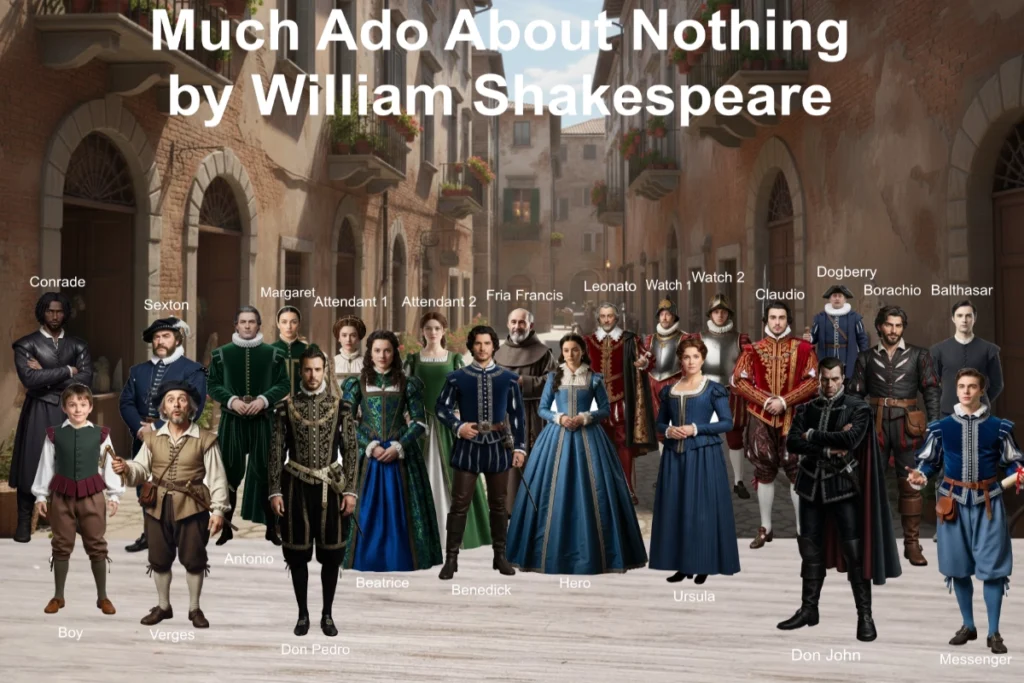
In short: Much Ado About Nothing pairs some of Shakespeare’s sharpest comic writing — the Benedick and Beatrice courtship — with a genuinely painful subplot about false accusation and public shame, giving it more emotional range than lighter comedies like Twelfth Night. Its intimate settings and clear eavesdropping scenes also make it one of the most satisfying Shakespeare plays to stage as a table production.
Ask people to name a Shakespeare comedy and you’ll most often get A Midsummer Night’s Dream, or perhaps Twelfth Night. Much Ado About Nothing tends to be the answer of people who’ve actually seen it performed — because once you’ve watched it done well, it lodges in your heart in a way that’s hard to explain and impossible to dislodge.
It’s funny, yes — genuinely, laugh-out-loud funny in a way that surprises people who approach Shakespeare with trepidation. But it’s also surprisingly deep, and the way it weaves comedy with real emotional stakes gives it a richness that rewards every encounter. Here’s why we think it might be the greatest of all Shakespeare’s comedies — and why it translates so beautifully to a tabletop stage.
The Plot, in Brief
The play is set in Messina, where Don Pedro, a prince, has just returned from a successful military campaign with his companions, including the soldier Benedick and the young nobleman Claudio. They are welcomed by Leonato, the governor, and his household, which includes his daughter Hero and his niece Beatrice.
Two love stories unfold in parallel. Claudio falls instantly and sincerely in love with Hero, and with Don Pedro’s help, they are quickly betrothed. Meanwhile, Benedick and Beatrice — who clearly have history, and clearly have feelings for each other that neither will admit — wage a war of wit that is as entertaining as anything in the English theatrical canon.
Don Pedro and his friends, with too much time on their hands and rather too much enjoyment of mischief, hatch a plot to trick Benedick and Beatrice into confessing their love. This is the play’s comic engine, and it runs beautifully. Meanwhile, the villain Don John — brooding, malicious, and bored — conspires to destroy Claudio and Hero’s happiness by making Claudio believe that Hero has been unfaithful. The consequences are painful before they are resolved.
Benedick and Beatrice: The Greatest Comic Double Act in English Theatre
There have been many great comic partnerships in English theatre, but none more perfectly constructed than Benedick and Beatrice. They are equals in wit, equals in intelligence, and equals in the armour they’ve each constructed to protect themselves from the vulnerability of love. Their verbal sparring is a delight from the moment they meet — and the genius of it is that every joke is also a revelation of character.
When Benedick says he would rather hear a dog bark at a crow than hear Beatrice speak, we laugh — but we also understand, immediately, that these are two people who have been wounded before and are terrified of being wounded again. The jokes aren’t just jokes; they’re defences. And when those defences finally come down, the emotional payoff is as satisfying as anything in more overtly serious drama.
The scenes where each of them is tricked into overhearing a staged conversation about the other’s hidden love are masterclasses in comic timing and dramatic irony. We know what’s happening; they don’t; and watching two brilliantly guarded people slowly, reluctantly, joyfully open themselves to love is one of the great theatrical pleasures.
The Wit
Shakespeare’s comedy is at its sharpest in Much Ado. The exchanges between Benedick and Beatrice have a speed and precision that feels almost modern — these are characters who think quickly, speak quickly, and are always three moves ahead of everyone around them.
But the comedy isn’t limited to the main couple. Dogberry and the Watch — the magnificently incompetent constabulary whose malapropisms and comic confusion provide the play’s broadest humour — are among Shakespeare’s most beloved creations. Dogberry’s magnificent misuse of language (“Comparisons are odorous,” “Our watch, sir, have indeed comprehended two auspicious persons”) is an entirely different register of comedy from Benedick and Beatrice’s rapier wit, and the contrast between them gives the play a wonderful range of tone.
Dogberry’s tangled speech actually predates the word we now use to describe it. The term “malapropism” wasn’t coined until 1775, nearly 180 years later, after Mrs. Malaprop, a character in Richard Brinsley Sheridan’s comedy The Rivals, made the very same kind of blunder her calling card.
The Darkness Underneath
What gives Much Ado its particular depth is the way it doesn’t pretend that love is uncomplicated. The sub-plot involving Hero and Claudio is genuinely painful: Hero is publicly shamed, falsely accused, and collapses under the weight of Claudio’s furious misplaced certainty. Her father immediately believes the worst of her. The scene of her humiliation at the altar is shocking even now, and it’s meant to be.
Shakespeare is making a serious point about the fragility of women’s reputations in a society governed by male honour, and about the catastrophic consequences of jealousy and insufficient evidence. These are not comfortable ideas, and the play doesn’t soften them. The resolution — in which Claudio is made to believe Hero is dead, performs penance, and then is given her back — is carefully calibrated to ensure that the joy of the ending has been properly earned.
This mixture of genuine comedy and real emotional stakes is what separates Much Ado from a lighter romp. It takes love seriously even as it laughs at the lengths to which people will go to avoid admitting to it.
On a Tabletop Stage
Much Ado About Nothing works wonderfully on a tabletop theatre. The play’s relatively intimate settings — houses, gardens, a church — translate beautifully to miniature scenic design. The sparkling dialogue benefits from the closeness of a small stage, where the audience is near enough to catch every nuance. And the play’s clear character delineations make it easy to bring to life even with a modest cast of figures.
The eavesdropping scenes are particularly satisfying in a tabletop production — the stage picture of characters hiding while others perform a staged conversation for their benefit is natural and funny in miniature, and those who perform it quickly grasp the theatrical magic of dramatic irony.
Frequently Asked Questions
Why is Much Ado About Nothing considered Shakespeare’s funniest play?
It combines the fast, modern-feeling verbal sparring of Benedick and Beatrice with the broad physical comedy of Dogberry and the Watch, giving it two distinct comic registers in one play. Few other Shakespeare comedies sustain this much genuine laughter while still carrying real emotional weight.
What is the plot of Much Ado About Nothing?
Two couples form in Messina: Claudio and Hero fall in love and become engaged, while Benedick and Beatrice are tricked into admitting feelings they’ve long denied. A villain, Don John, nearly destroys Claudio and Hero’s happiness with a false accusation before the play resolves both stories.
Who are Benedick and Beatrice?
Benedick and Beatrice are the play’s central couple, considered one of English theatre’s greatest comic double acts. Equally witty and equally guarded against love, they wage a running war of words that masks real feeling, until a trick played by their friends brings their defences down.
What does “malapropism” mean and where does it come from?
A malapropism is the comic misuse of a word for one that sounds similar. The term comes from Mrs. Malaprop, a character created by Richard Brinsley Sheridan in 1775 — though Shakespeare’s Dogberry made the same kind of error nearly 180 years earlier in Much Ado About Nothing.
Why does Much Ado About Nothing work well as a tabletop theatre production?
Its intimate settings, such as houses and gardens, translate naturally to miniature scenic design, and its close, dialogue-driven scenes suit the closeness of a small stage. The play’s eavesdropping scenes, where characters hide to overhear staged conversations, are especially effective in miniature.
Come and Discover It
Whether you’re approaching Much Ado About Nothing for the first time or returning to it as an old friend, a My Table Theatre production is a wonderful way to experience it. Our handcrafted theatres bring the play to life in a form that invites participation, conversation, and the kind of close engagement that only a small stage can offer.
Sign up below to be the first to hear when we launch — and to join a community of theatre lovers who believe that the best stories deserve to be told and retold.
Be part of the story — sign up below to join our FREE Community!
Create Theatre in Your Life
www.MyTableTheatre.com