
Treasure Island: The Story Behind the Story
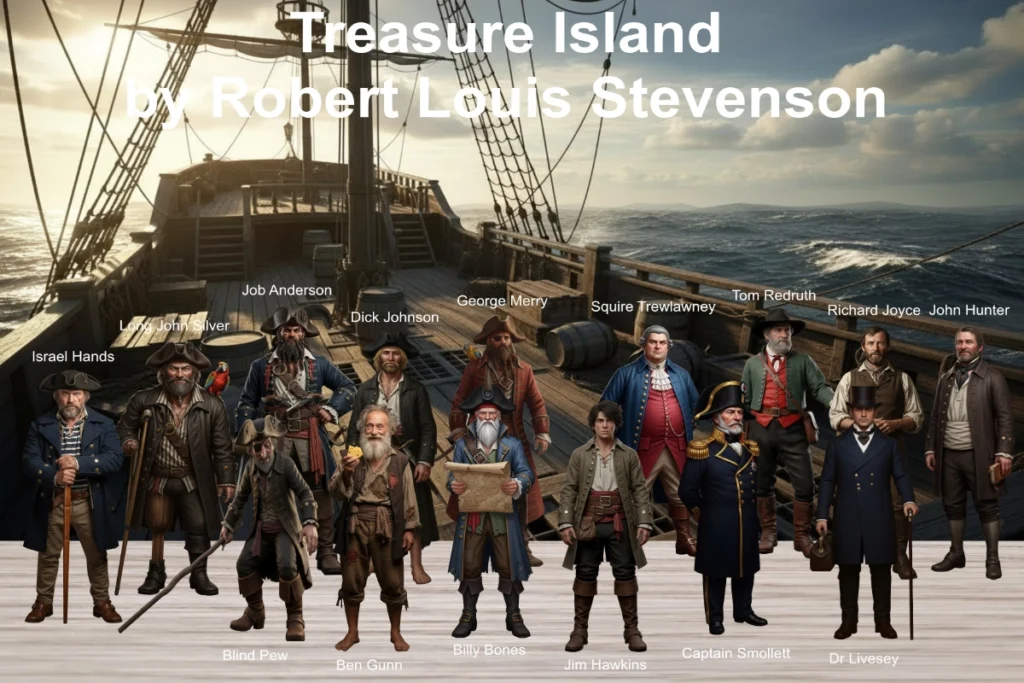
In short: Treasure Island began in 1881 as a map Robert Louis Stevenson drew to entertain his stepson on a rainy Scottish holiday, before growing into one of adventure fiction’s most enduring novels. Its lasting appeal rests on two towering creations — the morally ambiguous Long John Silver and the coming-of-age journey of Jim Hawkins — and its episodic, visually vivid structure makes it a natural fit for table theatre.
There are books that feel as if they’ve always existed — as if no one actually wrote them, but they simply arrived in the world fully formed, inevitable and complete. Treasure Island is one of those books. Its characters are so vivid, its story so compulsively readable, its atmosphere so perfectly conjured, that it’s hard to imagine a world without it.
And yet someone did write it, in a particular time and place, for specific reasons, drawing on specific sources and inspirations. The story behind Treasure Island is almost as fascinating as the story itself — and understanding it enriches the reading considerably.
How It Began: A Rainy Scottish Holiday
The origin of Treasure Island is one of the most charming stories in literary history. In the summer of 1881, Robert Louis Stevenson was staying at Braemar in the Scottish Highlands with his wife Fanny and his twelve-year-old stepson Lloyd Osbourne. The weather was typically awful — “… the weather was disgusting,” Stevenson later recalled — and the family was confined indoors.
To keep Lloyd entertained, Stevenson began drawing a map of an imaginary island. It was a detailed, lovingly rendered thing, complete with hills, harbours, and a marked spot for buried treasure. He wrote names on it: Skeleton Island, Spy-glass Hill, Cape of the Woods. The map fired his imagination so completely that he sat down and began writing the story to match it.
The opening chapters came quickly. Stevenson read them aloud to the family each evening, and they were an immediate success with Lloyd — and with Stevenson’s father Thomas, who arrived to visit and was so captivated by the tale that he contributed details about the treasure itself. The story was a genuinely collaborative family enterprise from the very beginning.
The Serial and the Novel
Stevenson submitted his story to Young Folks magazine, where it was serialised under the title Treasure Island, or the Mutiny of the Hispaniola from October 1881 to January 1882. The serial attracted modest attention at the time — the magazine’s readership was polite rather than enthusiastic.
But when the story was published as a novel in 1883, everything changed. The book was an immediate and emphatic success, praised by critics, devoured by readers young and old, and recognised almost immediately as something special. Gladstone, then Prime Minister, was said to have stayed up until two in the morning reading it. It made Stevenson’s name, and it has never been out of print since.
Long John Silver: The Greatest Villain in Adventure Fiction
Treasure Island gave literature one of its most enduring characters in Long John Silver, the one-legged cook who is simultaneously the most charming and the most dangerous person in the story. Stevenson was intensely proud of this creation, and rightly so: Silver is a genuinely original literary achievement, a villain who is also charismatic, occasionally heroic, and strangely sympathetic.
The character was inspired by Stevenson’s friend W. E. Henley, a writer and editor who had lost a leg and who combined tremendous physical presence with great charm and occasional ruthlessness. Stevenson told Henley directly that Silver was based on him, though with the darker qualities turned up considerably. Henley was apparently not offended.
What makes Silver so remarkable is his moral ambiguity. He is capable of murder — cold-blooded, calculating, without remorse. He is also capable of genuine affection for Jim Hawkins, and of actions that go beyond mere self-interest. He is the book’s most intelligent character and, in many ways, its most interesting. His final disappearance with a portion of the treasure — unpunished, uncatchable, beyond the reach of law or justice — is one of fiction’s great unsatisfying satisfactions. We’re glad he got away, even though we know we shouldn’t be.
Jim Hawkins and the Coming-of-Age Story
At the heart of Treasure Island is a coming-of-age story, and Jim Hawkins is one of literature’s most compelling young protagonists. He begins the novel as a boy — curious, brave enough, but inexperienced and dependent on the adults around him. He ends it as something considerably more: someone who has faced genuine danger, made real decisions under real pressure, and discovered resources in himself that he didn’t know he possessed.
The moment when Jim — alone, without help, without instructions — chooses to cut the Hispaniola adrift and set out to recapture it is one of the great decisive moments in adventure fiction. It’s a genuine leap into the unknown, taken on instinct and courage, and it changes the course of the story. Jim doesn’t know it will work; he acts anyway. That’s a lesson worth learning at any age.
The World Stevenson Created
Part of the enduring appeal of Treasure Island is the completeness of the world Stevenson created. The island itself — with its Spy-glass Hill, its stockade, its swamp and its sheltered anchorage — feels utterly real. The Hispaniola and her crew have the texture of lived experience. Even the atmosphere of the story — that particular combination of excitement and menace, of sunshine and shadow — is something Stevenson sustains with remarkable consistency throughout.
He drew on a wide range of sources. He was deeply read in sea literature, from Defoe’s Robinson Crusoe to the sea novels of Captain Marryat. He had read widely in the literature of buccaneers and pirates. And he had the mapmaker’s instinct — his island was fully imagined in three dimensions before he wrote a word of the story, which is why it feels so physically present throughout.
On a Tabletop Stage
Treasure Island is a natural fit for tabletop theatre. Its clear, episodic structure — the inn, the voyage, the island, the stockade, the treasure hunt — translates beautifully to a series of scenes. Its characters are vivid and distinct. Its action is physical and visual in a way that works well in miniature.
People who perform or watch it as a table theatre will find themselves inside one of the great adventure stories in a way that simply reading it can’t quite replicate. The physical presence of Jim, Silver, and the crew on a stage makes the story tangible in a new way — and the intimacy of a small stage gives even the quieter, more reflective moments their proper weight.
Frequently Asked Questions
How did Robert Louis Stevenson come to write Treasure Island?
He drew a detailed map of an imaginary island in 1881 to entertain his twelve-year-old stepson, Lloyd Osbourne, during a rainy holiday in Braemar, Scotland. The map so fired his imagination that he began writing the story to match it, reading each chapter aloud to the family as it was written.
Was Treasure Island a success when it was first published?
Not immediately. Its 1881-82 magazine serialisation drew only modest interest, but its 1883 publication as a novel was an immediate success, praised by critics and reportedly keeping Prime Minister Gladstone reading until two in the morning. It has never been out of print since.
Who inspired the character of Long John Silver?
Silver was inspired by Stevenson’s friend W. E. Henley, a writer and editor who had lost a leg and combined great physical presence with charm and occasional ruthlessness. Stevenson told Henley directly that Silver was based on him, with the darker qualities considerably heightened.
What is Treasure Island really about?
Beneath its adventure plot, it’s a coming-of-age story following Jim Hawkins as he moves from a dependent boy to someone capable of real courage and decisive action under pressure, alongside one of fiction’s most morally ambiguous villains in Long John Silver.
Why does Treasure Island work well as a tabletop theatre production?
Its clear, episodic structure — the inn, the voyage, the island, the stockade, the treasure hunt — translates naturally into a series of distinct scenes, and its vivid, physical action suits miniature staging particularly well.
Set Sail with Create Theatre
Our table production of Treasure Island brings this classic adventure to your own stage, with everything you need to mount your own production. It’s a perfect first theatrical — and a wonderful way to encounter one of the great books of the English language together.
Sign up below to be the first to hear when My Table Theatre launches, and to join a community of storytellers and theatre lovers who believe the best adventures are the ones you tell yourself.
Be part of the story — sign up below to join our FREE Community!
Create Theatre in Your Life
www.MyTableTheatre.com