
Making a Life in the Arts: Career Opportunities in Theatre, TV and Film
In short: Careers in theatre, TV and film extend far beyond acting to include writing, directing, design, technical and production roles, producing, and marketing and audience development, each with its own distinct training pathways. Early, hands-on experience — even something as small as a school play or a table theatre production — is where many of these careers begin.
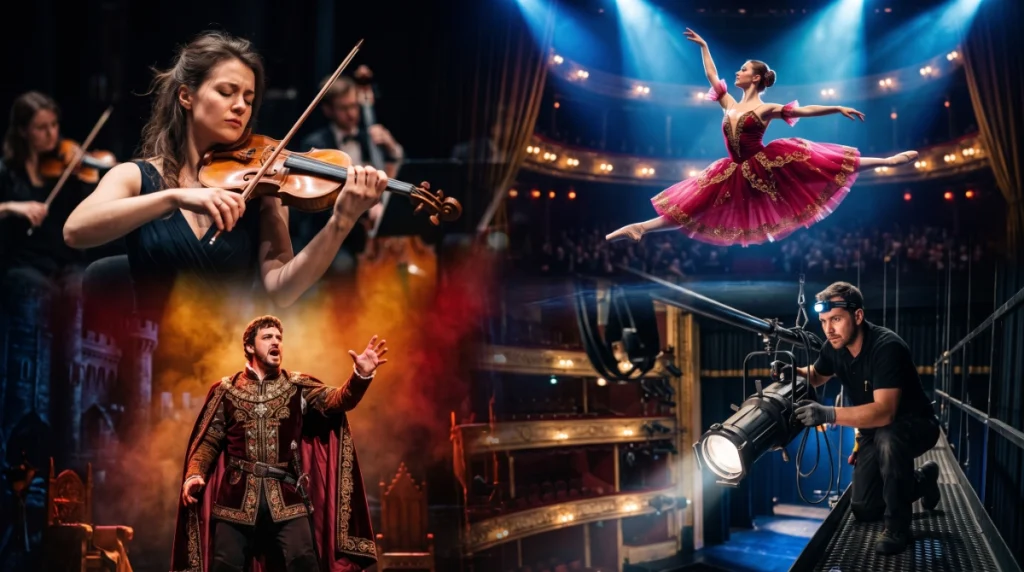
When people think about careers in theatre, TV and film, they tend to think of one thing: acting. And acting is wonderful — but it’s only one of dozens of careers that make up the creative industries. Behind every performance you’ve ever admired is a small army of writers, directors, designers, technicians, and producers whose work is just as skilled, just as demanding, and just as creative as anything happening in front of the camera or on the stage. Many of them love their work just as passionately as any performer.
This article is a guide to the full landscape of careers available in theatre, TV and film — for anyone who is drawn to the creative industries and wants to understand what’s really out there. Whether you’re a young person thinking about your future, a parent wondering what the arts genuinely have to offer, or simply someone curious about how the magic gets made, this is for you.
Performance: More Than Just Acting
Acting is the most visible career in the performing arts, but it exists within a much wider performance ecology. Actors work across theatre, film, television, radio, voiceover, and increasingly in video games and immersive experiences. The path is rarely straightforward — most professional actors train for three years at drama school, then spend years building a career through small roles, regional theatre, short films, and fringe productions before reaching the work they most want to do. It requires resilience, adaptability, and a genuine love of the craft that sustains you through the long periods between jobs.
But performance also includes dance, physical theatre, circus arts, puppetry, and musical theatre — each with its own training pathways and career structures. A musical theatre performer combines acting, singing, and dance, and typically follows a different training route from a straight actor. A puppeteer — as the traditions we’ve explored in other articles make clear — is a highly specialised performer whose skills are entirely distinct from conventional acting. A physical theatre practitioner may train in techniques like Lecoq or Viewpoints that are barely touched in conventional drama school curricula.
Voice acting deserves special mention as a career that has grown enormously in recent decades. Voiceover artists work in animation, audiobooks, documentary narration, commercial advertising, video games, and corporate media. The work is less glamorous than film acting in the conventional sense but is steady, well-paid, and deeply skilled — the ability to convey character, emotion, and nuance through voice alone is a genuine and demanding art.
Writing: The Foundation of Everything
Every film, every television series, every play begins with a writer. Screenwriters, playwrights, and television writers are the people who create the worlds and characters that everyone else brings to life — and their contribution, though often undervalued in public perception, is fundamental to everything that follows.
Playwriting is perhaps the most solitary of theatrical careers. The playwright works alone, developing their craft through reading, writing, and the gradual accumulation of produced work. Most playwrights begin by writing for fringe and small-scale theatre, seeing their work produced on tiny stages with minimal budgets, learning from each production what works on stage and what doesn’t. The journey from first play to full professional production can take years — but the playwright who finds their voice produces work that can outlast everyone else involved in a production.
Screenwriting is a different discipline, one that requires understanding not just how to construct a story but how stories work specifically for the screen — how they use image, pacing, and the particular grammar of film or television. Television writing has developed its own distinctive craft, particularly in the era of the long-form drama series, where a team of writers works together to develop complex multi-episode narratives under the leadership of a showrunner. Many of the most exciting writing careers in the current era are in television, where the ambition and scope of the work rivals anything in cinema.
Directing: The Art of the Whole
The director is responsible for the overall vision of a production — for taking a script and transforming it into a living theatrical or cinematic experience. It’s a role that requires an unusual combination of qualities: creative vision, organisational ability, people skills, and the authority to make hundreds of decisions under pressure while remaining open to unexpected discoveries.
Theatre directing and screen directing are related but distinct disciplines. A theatre director works with actors through a rehearsal process, developing performances through exploration, discussion, and iteration, then hands the production over to the actors on opening night. A film or television director controls every aspect of what the camera captures, from the performances to the framing to the lighting — and their creative work continues through the editing process long after the actors have gone home.
The path into directing varies enormously. Some directors train formally at drama school or film school. Others come through the industry as assistant directors — learning the craft from the inside by supporting more experienced colleagues. Many theatre directors begin as assistant directors at established companies, eventually being trusted with small-scale productions of their own, then working their way up to larger stages. The directing career is one of the most competitive in the industry, but also one of the most creatively satisfying.
Design: The World on Stage and Screen
Design in theatre, TV and film encompasses several distinct and highly skilled disciplines, each of which shapes the visual and sensory world that the audience experiences.
Set design — or production design in film and television — is the creation of the physical environment in which the story takes place. Set designers work closely with directors to develop spaces that express the world of the play or film: its period, its atmosphere, its social context. A great set design is not just a backdrop; it tells you something essential about the story before a word is spoken. Set designers typically train in theatre design at art school or conservatoire, developing skills in architectural drawing, model-making, spatial thinking, and materials.
Costume design is the creation of everything the performers wear — a discipline that combines historical research, character psychology, and practical craft. A costume designer reads a script and translates character into clothing: the cut, fabric, colour, and condition of what someone wears tells the audience who they are. Costume designers often work with a team of makers — cutters, stitchers, milliners, shoemakers — to realise their designs, and the relationship between the designer’s vision and the maker’s craft is one of the richest collaborations in the industry.
Character design is a related but distinct discipline, particularly central to animation, video games, and puppetry. A character designer develops the visual identity of a figure from the ground up — silhouette, proportion, colour, and expression — so that personality and story are legible at a glance, long before the character speaks or moves. It’s a career that draws heavily on illustration and sculpture as much as on theatrical training.
Lighting design shapes how we see everything on stage and screen. A lighting designer works with light as a creative medium — using it to establish time of day and season, to create atmosphere, to focus attention, and to evoke emotional states. The craft requires both technical expertise (understanding lighting equipment, programming sophisticated control systems) and artistic sensitivity (understanding how light affects colour, shadow, and the perception of space). It is one of the careers in theatre that has seen the most dramatic technological change in recent decades, with digital lighting systems opening up creative possibilities that were simply unavailable a generation ago.
Sound design has similarly evolved into a highly sophisticated discipline. Sound designers create the entire sonic world of a production — from the music that underscores emotional moments to the ambient sounds that establish place to the effects that punctuate action. In film and television, sound design is recognised as one of the major creative contributions to a production, with its own Academy Award category. In theatre, it has grown from a relatively minor technical role into a central creative one.
Technical and Production: Making It Happen
Every production, however creative its vision, depends on the technical and production professionals who make it physically possible. These careers are often overlooked in discussions of the arts, but they are essential, highly skilled, and frequently very well paid.
Stage management is the spine of any theatrical production. Stage managers coordinate every aspect of a production’s logistics — scheduling rehearsals, managing communication between departments, calling cues during performances, and ensuring that everything runs on time and on budget. It requires exceptional organisational ability, calm under pressure, and the diplomatic skill to manage complex relationships between creative personalities. Many of the most capable people in the theatre industry are stage managers, and their contribution to the work is immeasurable.
Technical theatre encompasses the operation and maintenance of lighting, sound, and staging equipment — the people who make the lighting designer’s vision actually happen, who run the sound desk during a show, who operate the fly system that raises and lowers scenery. Technical theatre is increasingly a graduate career, with specialist courses at many universities and conservatoires, and it offers genuine creative engagement alongside technical expertise.
In film and television, the camera, grip, and electrical departments perform equivalent functions — the cinematographer (or director of photography) leads a team of camera operators, focus pullers, and assistants who capture the images; the grip and electrical departments manage the physical and lighting infrastructure of the shoot. These are skilled, well-paid, and often physically demanding careers that sit at the heart of the film-making process.
Producing: Where Creativity Meets Commerce
Producers are the people who make productions possible — who find the money, assemble the team, manage the budget, and shepherd a project from initial idea to finished performance or screen. It is a role that requires an unusual combination of creative passion and business acumen, and the best producers are as essential to a production’s success as its director or its lead performers.
In theatre, producers range from the independent commercial producer who raises private investment for West End productions to the artistic directors of subsidised companies who balance creative ambition with institutional responsibility. In film and television, the producer’s role is multifaceted and varies considerably by project: an executive producer may be primarily a financier; a line producer manages the day-to-day logistics of a shoot; a creative producer works closely with writers and directors on the development of the project from the ground up.
Production management — the discipline of managing the physical and financial logistics of a production — is a distinct and crucial career that sits between the producing and technical worlds. Production managers create and manage budgets, schedule the work, and solve the endless practical problems that arise when creative ambitions meet physical and financial reality. It is a career that rewards clear thinking, practical problem-solving, and the ability to say “no” diplomatically but firmly.
Marketing, Communications and Audience Development
Theatre, TV and film are industries that need audiences, and the people who find and develop those audiences are as important to the health of the arts as anyone on stage or screen. Marketing and communications professionals in the arts work across digital and print media, social platforms, press and PR, and community engagement — developing strategies that connect productions and institutions with the people who will love them.
Arts marketing has become an increasingly sophisticated discipline, drawing on the tools and techniques of commercial marketing while navigating the particular challenges of selling cultural experiences. An arts marketing director at a major theatre company needs to understand audience data and digital analytics as well as they understand the productions they’re selling. It is a career that rewards both creative thinking and analytical rigour.
Education and community engagement is a growing area of work within arts organisations — the people who take theatre into schools, run workshops for young people, develop participatory programmes for communities who wouldn’t normally access the work. This is a career that combines theatrical skill with teaching ability and a genuine commitment to the social value of the arts. It is also, increasingly, a career that arts organisations recognise as central to their purpose rather than peripheral to it.
Where Theatre Begins: The Value of Early Experience
Almost everyone who works in theatre, TV and film will tell you that their love of the art form began early — in a school play, a drama club, a family trip to the theatre, or, sometimes, through an encounter with a story told in an unexpected and intimate form. The habits of imagination, collaboration, and creative thinking that the arts develop are habits that form early and last a lifetime.
For young people drawn to the creative industries, the most valuable thing they can do is engage with theatre and performance in any form available to them — to make things, tell stories, work with others, and discover what it feels like to bring a character or a production to life. Experience matters in these industries, and the earliest experiences — even the smallest ones — are where it all begins.
At Create Theatre, we believe that the miniature stage or the stage at home is where many great theatrical imaginations first catch fire. Our handcrafted tabletop theatres put the whole experience of theatre — writing, directing, performing, designing — within reach of anyone with a story to tell. Who knows where that first spark might lead?
Frequently Asked Questions
What careers exist in theatre, TV and film besides acting?
Beyond acting, careers include writing (playwriting, screenwriting, television writing), directing, design (set, costume, character, lighting, sound), technical and production roles, producing, and marketing and audience development. Each has its own distinct training pathway and required skill set.
What is the difference between theatre directing and screen directing?
A theatre director develops performances with actors through a rehearsal process, then hands the production over on opening night. A film or television director controls every aspect the camera captures, from performance to framing to lighting, and continues creative work through editing long after filming ends.
What does a stage manager actually do?
Stage managers coordinate every logistical aspect of a production, scheduling rehearsals, managing communication between departments, calling cues during performances, and ensuring everything runs on time and on budget, requiring strong organisational ability and calm under pressure.
What is the difference between a set designer and a costume designer?
A set designer creates the physical environment in which a story takes place, expressing period, atmosphere, and social context, while a costume designer creates everything performers wear, translating character into clothing choices like cut, fabric, and colour.
How important is early experience for a career in the performing arts?
Very important. Most people working in theatre, TV and film trace their interest back to early experiences like a school play, drama club, or an intimate encounter with storytelling, and engaging with performance in any available form is considered the most valuable starting point for young people.
Join Us
Whether you’re at the beginning of a creative journey or well along the way, Create Theatre is a community for people who love theatre in all its forms. Sign up below to be the first to hear when we launch, and to join a growing community of theatre makers, lovers, and dreamers.
Be part of the story — sign up below to join our FREE Community!
Create Theatre in Your Life
www.MyTableTheatre.com