
Introduction
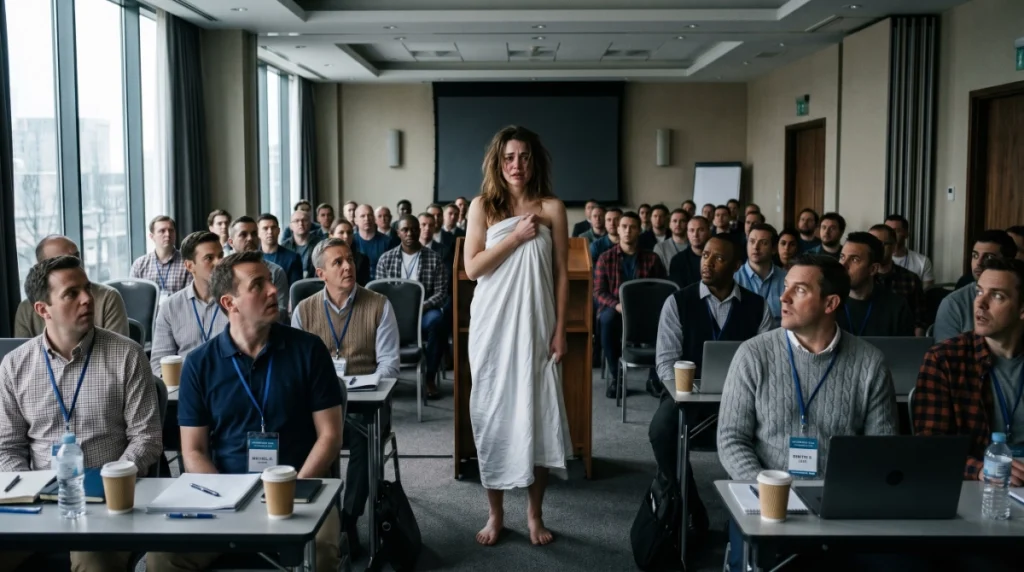
Picture a hotel conference room on a grey morning. Rows of offshore managers, badges round their necks, coffee going cold, settling in for the first lecture of a health and safety conference. Then the door bursts open, and a young woman walks in wearing nothing but a bed sheet. The room snaps fully awake in an instant. What follows isn’t a stunt or a distraction. It’s a drunken, grief-stricken monologue about a husband who never came home from an offshore accident, delivered by a trained actor, and it lands the safety message of that entire conference more effectively than any slide deck possibly could.
That is acting in the workplace: a genuine, paying corner of the profession that has almost nothing to do with theatres, scripts you’d find in a bookshop, or auditions for the next big drama. It is acting deployed as a tool, hired by businesses, hospitals, and training organisations for one very specific reason: a skilled performer can make people feel something that a PowerPoint slide never will, and feeling something is very often what changes behaviour. For young actors weighing up where a career in performance might actually lead, this is a corner of the industry well worth knowing exists.
The Pioneers: How John Cleese Made Training Funny
The clearest, most famous example of acting being put to work for business is a company most people of a certain generation will instantly recognise: Video Arts. Founded in 1972 by John Cleese and the writer Sir Antony Jay, Video Arts built its entire business on a simple, slightly cheeky observation. As Cleese put it, people learn nothing when they’re asleep and very little when they’re bored, and most corporate training at the time was reliably putting people to sleep. Their solution was to make training films that were genuinely, properly funny, using some of Britain’s best-known comic actors to dramatise exactly the kind of workplace failure everyone secretly recognised: terrible meetings, hopeless interviews, dreadful customer service.
Cleese starred in many of the films himself, but Video Arts went on to recruit an extraordinary roster of acting talent across the decades, including Ronnie Barker, Ronnie Corbett, Rik Mayall, Stephen Fry, Hugh Laurie, Emma Thompson, Dawn French, and later Olivia Colman, Robert Webb, and Ricky Gervais. The business grew rapidly through the 1980s, and Cleese eventually sold the company for £43 million in 1989, having proven, rather conclusively, that comic acting talent and serious business training were not opposites at all. Video Arts still operates today, now producing the same kind of work as e-learning content rather than VHS tapes, which tells you something important: the underlying need that built the company in 1972 hasn’t gone away. Organisations still need someone to make a learning point land, and they still know that a script and a trained performer do that better than a bullet point list ever could.
A Different Kind of Performance: Role Play and Simulation
Sitting alongside scripted training films is an entirely separate, equally substantial branch of workplace acting: live role play and simulation, where the performance happens in real time, in front of the very people it’s meant to train. This is most established in healthcare, where actors trained as “simulated patients” work alongside medical and nursing students, portraying everything from a frightened patient receiving difficult news to a relative struggling with a hospice admission, allowing trainee professionals to practise difficult conversations in a setting where getting it wrong costs nothing but a moment’s discomfort.
The same skill set has spread well beyond medicine. Corporate role play companies now employ trained actors to play difficult customers, conflicted colleagues, or underperforming staff, giving real employees a safe space to practise negotiation, feedback, and conflict resolution before they have to do it for real. For an actor, this is genuinely demanding work. It calls for the ability to improvise convincingly and consistently in character, to react authentically no matter what an untrained participant throws at the scene, and then, often, to step out of character afterwards and give thoughtful, constructive feedback on how the interaction actually felt from the other side. It is, in a very real sense, an actor and a teacher’s skill set fused into a single job, and there are professional role play agencies across the UK actively recruiting and training performers to do exactly this kind of work as a genuine, ongoing source of income.
When the Story Itself Is the Training: Forum Theatre
The offshore scene that opens this article belongs to a third, distinct tradition, one with deep roots in political theatre. In the 1960s and 70s, the Brazilian director Augusto Boal developed what he called Forum Theatre as part of his wider Theatre of the Oppressed, originally designed to help disenfranchised communities confront real social problems through drama. The format is deceptively simple: actors perform a scene depicting a genuine conflict or difficulty, and the audience, no longer just spectators, can call “stop,” step into the scene themselves, or direct the actors to try a different approach, testing out solutions together rather than being told the answer from the front of the room.
That same structure has been adopted wholesale by the corporate and industrial training world under the banner of drama-based training, and it’s precisely the territory the offshore safety scene sits within. The oil and gas sector has specifically used drama to tackle a problem that no safety manual can solve on its own: the cultural and relational barriers that stop a worker from speaking up when they see something unsafe. Workers might worry about offending a senior colleague, assume someone more experienced already knows what they’re doing, or simply feel pressure to get the job done and move on. A scripted, fully embodied performance, drawing on grief, fear, or loss in a way a bullet-pointed risk assessment never could, makes that human cost impossible to look away from, in exactly the way that bed-sheet-clad monologue clearly did for an entire room of offshore managers who arrived expecting nothing but slides.
What This Means for a Young Actor
It’s worth being plain about why this matters for anyone starting out in the profession. The conventional image of an acting career runs through drama school, agents, auditions, and a hoped-for break in television, film, or theatre. That path is real, and worth pursuing if it’s what you want. But it is also narrow, and the gaps between paid jobs on that path are notoriously long. Workplace acting, in its various forms, training films, simulated role play, forum theatre and drama-based corporate work, is a genuinely separate, parallel industry that pays actual working actors actual money, draws on exactly the same core craft, and rarely gets mentioned in drama school prospectuses.
The skills this work demands are not lesser versions of “real” acting. If anything, they ask for more in certain respects: the ability to improvise truthfully and indefinitely in character, to read a room of non-actors and respond to whatever unscripted thing they do, to hold real emotional truth in a five-minute scene that has to land its point on the first viewing, with no second take. Actors who do this work well tend to describe it as some of the most demanding and most satisfying work they do, precisely because the audience isn’t there to be entertained. They’re there to learn something that might genuinely keep them, or someone they work alongside, safe.
For a young actor mapping out where a career in performance might actually take them, it’s worth knowing that the stage isn’t only found in theatres. Sometimes it’s a conference hotel on a Tuesday morning, in front of an audience who didn’t know they were about to watch a piece of theatre at all, right up until the moment it changed how they thought about going home safely that evening.